

Facts on this page were checked in September 2026. Sources are listed with each figure. Fiscal years in Pakistan run from July to June.
The short answer
| Question | Answer |
|---|---|
| Known for | Pakistan's port city and largest trading center |
| Main export products | Apparel and denim, Home textiles, Towels, Leather goods, Rice and food products |
| How goods leave | By sea from Karachi Port or Port Qasim. Air cargo from Jinnah International Airport |
| Province | Sindh |
| Do you buy our goods? | No. We are your US partner, not a distributor. You sell directly to US buyers. |
Karachi exports: the numbers
| Figure | Value | Source |
|---|---|---|
| Share of Pakistan's exports that leave through Karachi's ports | About 76 percent | Pakistan Single Window (PSW) assessment report, as reported by ProPakistani, 2024 |
| Port Qasim share of total exports | 40.4 percent | Pakistan Single Window (PSW) assessment report, as reported by ProPakistani, 2024 |
| Karachi Port share of total exports | 34.3 percent | Pakistan Single Window (PSW) assessment report, as reported by ProPakistani, 2024 |
| Karachi Port cargo capacity | Over 125 million tons a year, including 4.25 million containers (TEU) | Ministry of Maritime Affairs, as reported by APP |
What Karachi makes for the US market
Karachi is the country's biggest industrial and trading city. Its mills and factories make garments, denim, towels, home textiles and leather goods. Its food companies pack rice, spices and seafood. Many Karachi trading houses also export goods made across Sindh and Punjab, from Himalayan salt to marble.
Karachi's textile mills, garment units, leather makers and food packers ship from Karachi Port and Port Qasim, the main sea routes to the US. Many Karachi trading houses also export goods made across Sindh and Punjab.
- Apparel and denim
- Home textiles
- Towels
- Leather goods
- Rice and food products
- Spices
- Carpets and rugs
- Marble and onyx
- Himalayan salt

Where the factories are
| Area | What is there |
|---|---|
| SITE (Sindh Industrial Trading Estate) | Karachi's oldest industrial estate, west of the city center, with textile, garment and food units |
| Korangi Industrial Area and Landhi | Garments, towels, leather and the Korangi tannery cluster |
| Karachi Export Processing Zone, Landhi | Run by the Export Processing Zones Authority for export-only manufacturers |
| North Karachi and Federal B Area industrial areas | Garments, knitwear and small manufacturing units |
| Port Qasim industrial zone and Bin Qasim | Heavy industry, steel, food processing and large mills near the port |
| Hub Industrial and Trading Estate, across the Hub River in Balochistan | About 1,226 acres run by the Lasbela Industrial Estates Development Authority, home to national and multinational manufacturers |
How goods leave Karachi
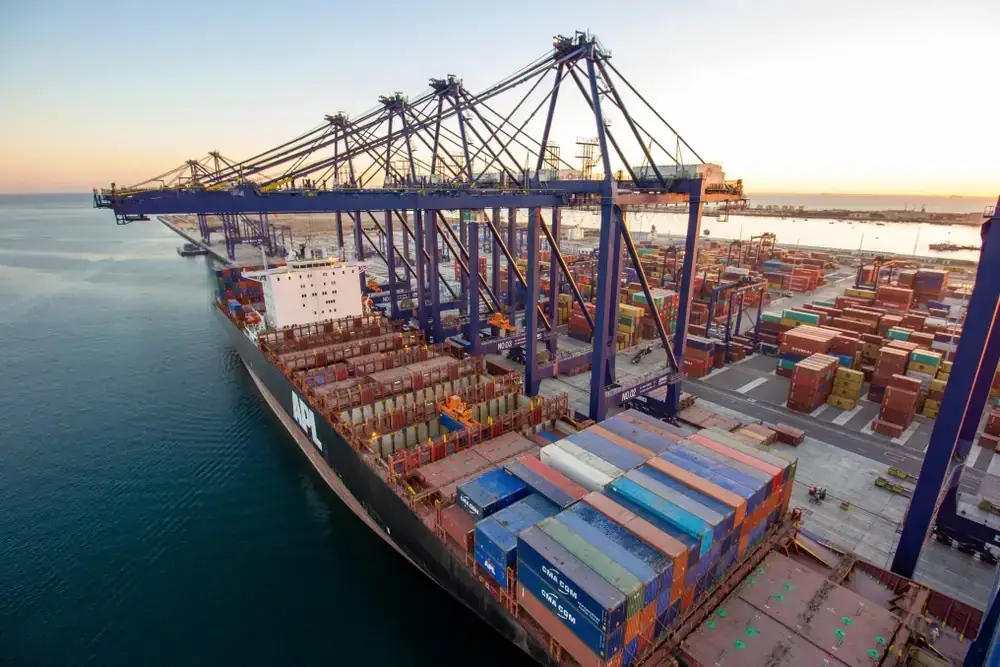
Karachi has Pakistan's two main seaports. Karachi Port is run by the Karachi Port Trust (KPT), a federal body under the Ministry of Maritime Affairs, while the container terminals inside it are run by private operators on long concessions. Port Qasim is a separate port about 35 km east, run by the Port Qasim Authority (PQA). A third port, Gwadar in Balochistan, is run by China Overseas Port Holding Company under a 40-year concession, but it handled less than 1 percent of Pakistan's seaborne trade in 2022-23.
Karachi's ports and who runs them
| Terminal | Location | Operator |
|---|---|---|
| Karachi Gateway Terminal (KGTL) | East Wharf, berths 6 to 10 | AD Ports Group (UAE) with Kaheel Terminals, 50-year concession from 2023. Took over from Pakistan International Container Terminal (PICT) |
| Karachi Gateway Terminal Multipurpose (KGTML) | East Wharf, berths 11 to 17 | AD Ports Group, 25-year concession for bulk and general cargo |
| Karachi International Container Terminal (KICT) | West Wharf, berths 26 to 30 | Hutchison Ports (Hong Kong). Karachi's first container terminal, operating since 1996 |
| South Asia Pakistan Terminals (SAPT) | South Wharf, Keamari Groyne | Hutchison Ports. A deep-water terminal that can take large container ships |
| Qasim International Container Terminal (QICT) | Port Qasim, about 35 km east of Karachi Port | DP World (Dubai) |
Karachi Port is owned by the federal government and managed by the Karachi Port Trust. Port Qasim is managed by the Port Qasim Authority. Private terminal operators pay the port authorities a royalty for each container they handle.
Business bodies in Karachi
- Karachi Chamber of Commerce and Industry (KCCI)
- Korangi Association of Trade and Industry
- SITE Association of Industry
- Pakistan Tanners Association
- Rice Exporters Association of Pakistan (REAP)
We name these organizations to help you find local support. It does not mean we have a relationship with them.
How we help Karachi exporters
- Register your US company with a Chicago address and US phone number
- Build your English website and catalog with US sizes and prices, built to be found on Google
- Set up Amazon USA or a Shopify store for retail sales
- Find US buyers by cold outreach, send samples from Chicago and follow up every quote
- Check buyers before you ship on credit
You never need to travel. We work by phone, video call and email, in English and Urdu. Chicago is 10 to 11 hours behind Pakistan, so US buyer questions are answered during the US working day.
How to start
- Tell us about your products. Use our quote form or call us.
- Get a plan and price. We reply by email with the package that fits and the full cost.
- We set up your US presence. Company, website, catalog and store, depending on your plan.
- We start selling. Outreach to US buyers begins and you get a report every month.
Common questions
Which port do Karachi exporters use to ship to the US?
Most sea shipments to the US leave from Karachi Port or Port Qasim. Your freight forwarder books the space and your buyer or our partner broker clears it in the US.
Can you help a Karachi trading company, not a factory?
Yes. We work with factories and with trading companies that export on behalf of factories.
Which Karachi port should my shipment use?
Your freight forwarder books the ship and terminal. Container lines call at KGTL, KICT and SAPT in Karachi Port and at QICT in Port Qasim. For US buyers, what matters most is the sailing schedule, the transit time and a correct export declaration in PSW.